Books

Carnal Crimes: Sexual Assault Law in Canada, 1900 – 1975
Toronto: Irwin Law, 2008
About
Carnal Crimes: Sexual Assault Law in Canada, 1900-1975 is an engaging and powerful book about sexual assault crimes in Canadian history by one of Canada’s foremost legal historians. Using a case-study approach, Constance Backhouse explores nine sexual assault trials from across the country throughout the twentieth century. We move from small towns to large cities, from the Maritimes to the Northwest Territories, from the suffrage era to the period of the women’s liberation movement. Each of these richly-textured vignettes offers insight into the failure of the criminal justice system to protect women from sexual assault, and each is highly readable and provocative. The most moving chapters document the law’s refusal to accommodate a woman who could only give evidence in sign language, and the heartbreak of a child rape trial. Backhouse deals sensitively and deftly with these difficult stories.
Recognition
David W. Mundell Medal (2011)
Canadian Law & Society Association Book Prize (2009)
Harold Adams Innis Prize, short-list (2009)
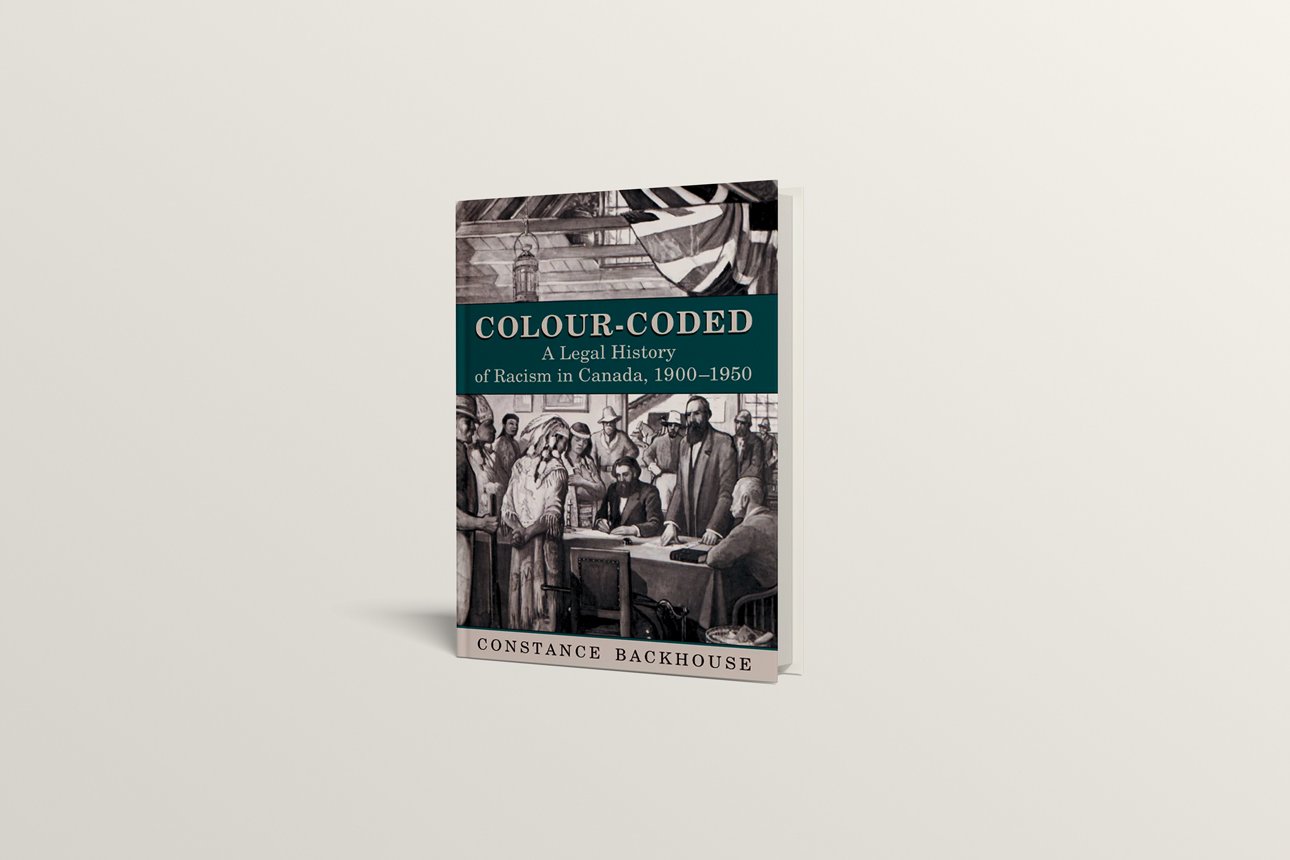
Colour-Coded
A Legal History of Racism in Canada 1900-1950
University of Toronto Press, 1999
About
Historically Canadians have considered themselves to be mostly free of racial prejudice. In Colour-Coded, Constance Backhouse illustrates the tenacious hold that white supremacy had on our legal system and underscores the damaging legacy of inequality today. She presents detailed narratives of six court cases involving Indigenous, Chinese Canadian, and African Canadian individuals, each giving evidence of blatant racism created and enforced through law. From the prosecution of traditional Indigenous dance to the trial of Chinese restaurateurs for hiring white women, to the celebrated Viola Desmond segregation case, to the cross-burning of the "Ku Klux Klan of Kanada," Backhouse has selected vivid examples of central moments in the history of Canadian racism. She demonstrates how legal racism encompassed the lowest and highest courts in the country.
Book (pdf)
Research endnotes (pdf)
Recognition
Joseph Brant Award, Ontario Historical Society (2002)
De la couleur des lois
Une histoire juridique du racism au Canada entre 1900 et 1950
Les Presses de l’Université d’Ottawa, 2010

About
Quelques notes sont directement liées aux cas illustrés dans le texte et s’adressent à tous les lecteurs de cet ouvrage. Il y a aussi d’autres notes de recherche considérablement plus longues, qui traitent d’ouvrages secondaires, du cadre législatif complet et de plusieurs autres cas liés au domaine de recherche. Celles-ci intéresseront principalement les universitaires qui travaillent directement dans ce champ de recherche. Étant donné la longueur des notes de recherche et du nombre restreint de lecteurs qui pourraient avoir besoin d’y accéder, il a été décidé de ne pas les inclure dans le livre et de ne pas dépenser d’importantes sommes pour les faire traduire. Quiconque le souhaite peut directement télécharger le document Word des notes anglaises, par voie électronique.
View research endnotes (pdf)
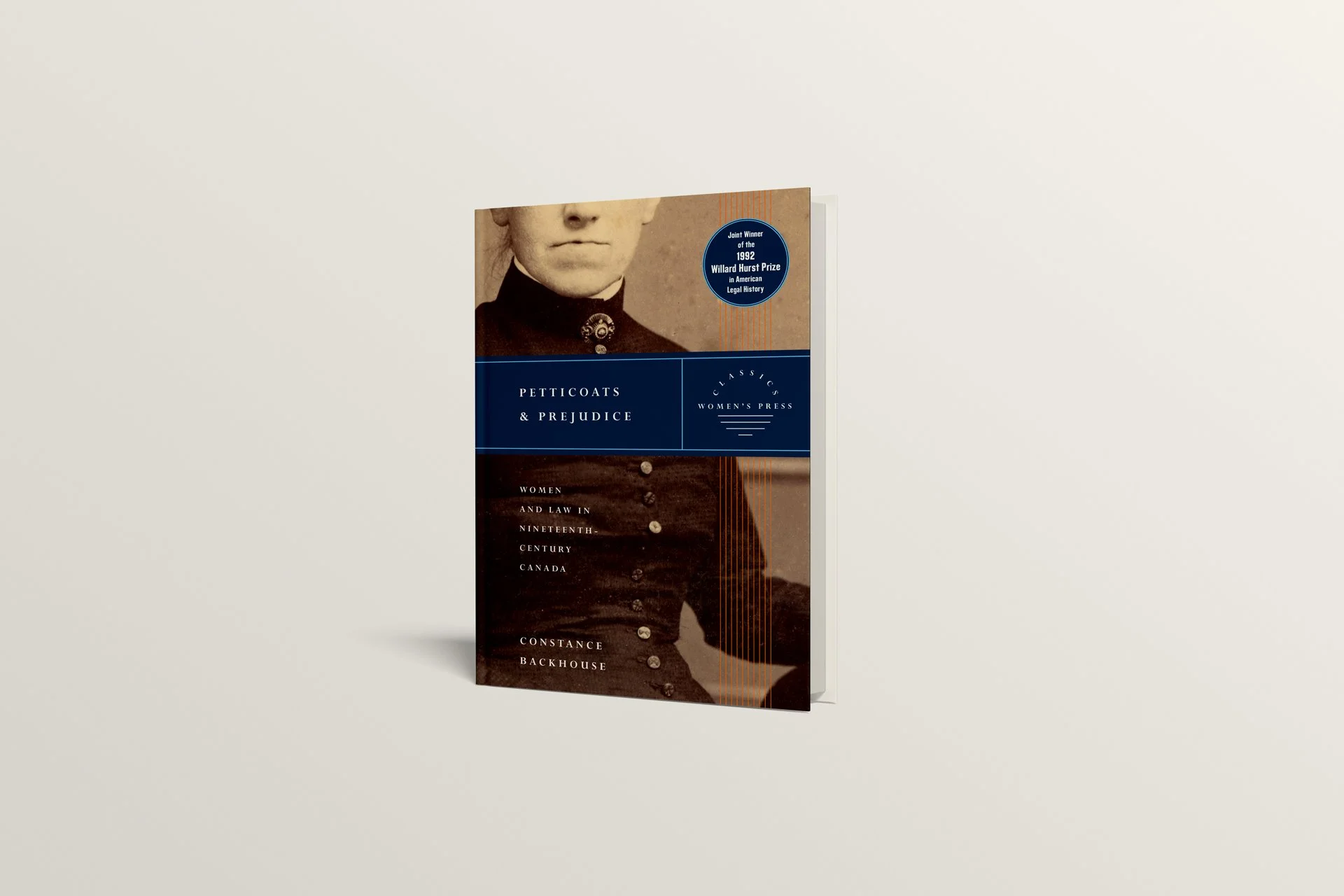
Petticoats & Prejudice: Women and Law in Nineteenth-Century Canada 2nd ed. (Toronto: Canadian Scholar’s Press/Women’s Press, 2015) pp. 466
New edition of 1991 publication which was awarded the 1992 Willard Hurst Prize in American Legal History
About
Euphemia Rabbitt, who courageously resisted a vicious rape attempt, and Clara Brett Martin, the first woman admitted to the bar in the British Empire, were widely admired in their own time. But Ellen Rogers, a prostitute who believed that all women should be protected by law from sexual assault and was viciously maligned for her ideas, and Nellie Armstrong, whose attempt to wrest her young children from her estranged and violent husband went down to defeat, were independently minded women hidden, until now, from historical records.
Each of these women’s stories lends a new meaning and dimension to the word “heroism.” Petticoats and Prejudice explores the legal status of women in nineteenth-century Canada by examining the cases of these and other individual women who were swept up into the legal process as litigants, accused criminals or witnesses.
Recognition
Willard Hurst Prize in American Legal History (1992)
Reckoning with Racism
Police, Judges, and the RDS Case
University of British Columbia Press, 2022
About
In 1994, a white police officer arrested a Black teenager, placed him in a choke hold, and charged him with assault and obstructing arrest. In acquitting the teen, Judge Corrine Sparks – Canada’s first Black female judge – remarked that police sometimes overreacted when with dealing with non-white youths. The acquittal was appealed and ultimately upheld, but most of the white judges who reviewed the decision critiqued Sparks’s comments. Reckoning with Racism considers the RDS case, in which the Supreme Court of Canada fumbled over its first complaint of judicial racial bias. This is an enthralling account of the country’s most momentous race case.
Recognition
Best Books in Canada for 2022, Hill Times (2023)
Claire L’Heureux Dubé
a life
University of British Columbia Press, 2017

About
Both lionized and vilified, Claire L’Heureux-Dubé shaped the Canadian legal landscape – and in particular its highest court. The second woman appointed to the Supreme Court of Canada and the first from Quebec, she was known as “the great dissenter” on the bench. L’Heureux-Dubé’s innovative legal approach was anchored in the social, economic, and political context of her cases. Constance Backhouse employs a similar tactic. She explores the socio-political and cultural setting in which L’Heureux-Dubé’s life unfolded, while offering deep analysis of her intimate personal life.
“A compelling book about a compelling judge by a compelling author. Claire L’Heureux Dubé is a bold, brilliant, and brave woman who transformed Canadian law. Constance Backhouse is also a bold, brilliant, and brave woman who has transformed Canadian legal history. This is a meeting between two giants, the ebullient and forceful Québec legal mind and the eminent Anglo-Canadian feminist scholar. I laughed, I cried, I debated, and I reflected. I read it in two days. So should you.”
—Nathalie Des Rosiers, MPP (Ottawa-Vanier) and professor, Faculty of Law, University of Ottawa
“This is a biography of one of Canada’s most fascinating Supreme Court justices, written by one of Canada’s most accomplished authors. It is beautiful, brilliant, transparent, subtle, and honest.”
—Kim Brooks, professor, Schulich School of Law, Dalhousie University
“Professor Backhouse has taken her legal expertise, stirred in prodigious amounts of research, added some spicy feminist analysis, iced the whole with her inimitable writing style, and served up a magnificent biography. For many English Canadians this detailed portrait will be an eye-opener, one that may well contribute to a greater understanding of Quebec history and culture through its comprehensive, intimate, and insightful portrait of Claire L’Heureux-Dubé herself. This book is a triumph.”
—Philip Girard, professor, Osgoode Hall Law School, York University
Recognition
W. Wesley Pue Book Prize, Canadian Law & Society Association (2017)
City of Ottawa Book Award, short-list (2018)
Shirley Greenberg Prize in Feminist Research (2019)
Canada Prize in the Humanities and Social Sciences, finalist (2019)
Two Firsts
Bertha Wilson and Claire L’Heureux-Dubé at the Supreme Court of Canada
Second Story Press, 2019

About
Bertha Wilson and Claire L’Heureux-Dubé were the first women judges on the Supreme Court of Canada. Their 1980s judicial appointments delighted feminists and shocked the legal establishment. Polar opposites in background and temperament, the two faced many identical challenges.
Constance Backhouse’s captivating narrative explores the sexist roadblocks they faced in education, family life, law practice, and on the courts. She profiles their different ways of coping, their landmark decisions for women’s rights, and their less stellar records on race. To explore the lives and careers of these two path-breaking women is to venture into a world of legal sexism from a past era. The question becomes, how much of that sexism has been relegated to the bins of history, and how much continues?
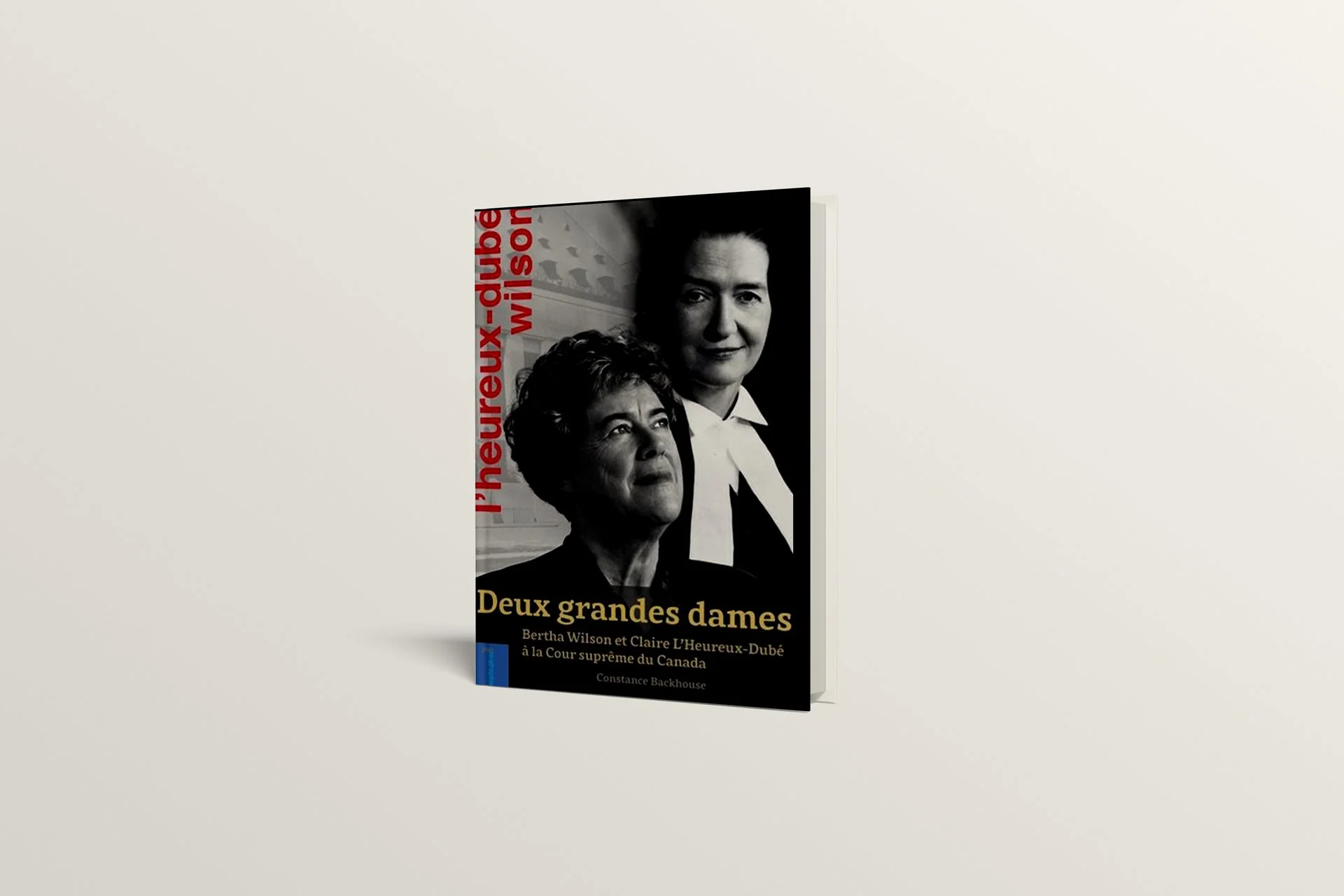
Deux Grandes Dames
Bertha Wilson & Claire L’Heureux-Dubé à la Cour suprème du Canada (French version)
Les Presses de l’Université d’Ottawa, 2021
About
Les deux grandes dames ont été les premières femmes juges à La Cour suprême du Canada. Leurs nominations judiciaires dans les années 1980 ont ravi les féministes et bousculé l’establishment juridique. L’une représentait le Canada anglais, l’autre le Québec. De milieux et de tempéraments opposés, elles ont pourtant été confrontées à des défis similaires. Constance Backhouse se penche sur les obstacles qu’ont affrontés ces deux femmes en raison de leur sexe au cours de leur études, dans leur pratique du droit et au sein des cours de justice.
Rappeler les efforts déployés par ces deux grandes dames pour vaincre le sexisme systématique de l’époque révèle les fondements des inégalités de genre de notre passé. La question qui se pose aujourd’hui est la suivante : le sexisme d’antan est-il réellement relégué aux oubliettes?
Recognition
Shaughnessy Cohen Prize, long-list, Writers Trust of Canada (2022)
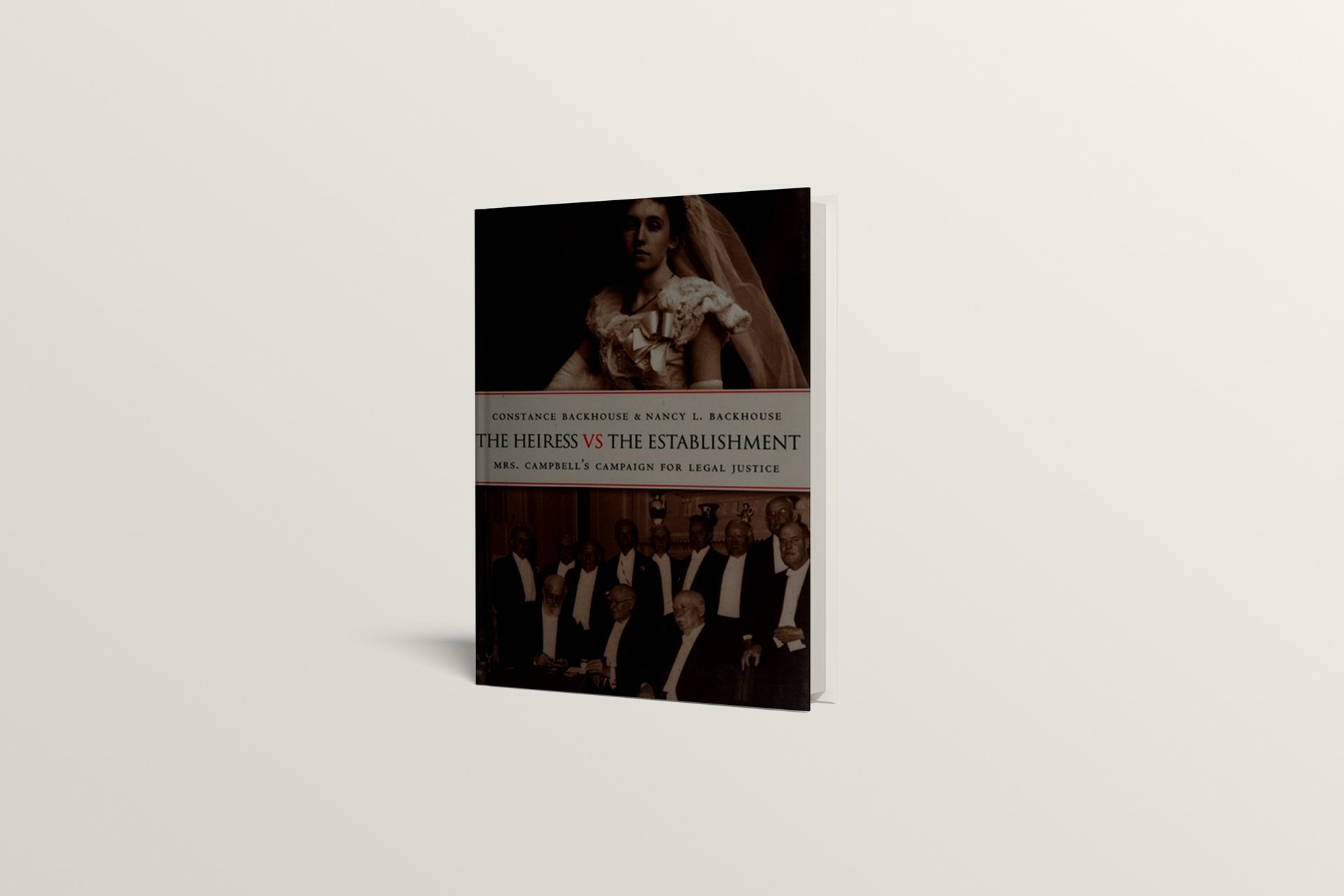
The Heiress vs The Establishment
Mrs. Campbell’s Campaign for Legal Justice
Co-Author: Nancy L. Backhouse
University of British Columbia Press, 2004
About
In 1922, Elizabeth Bethune Campbell, a Toronto-born socialite, unearthed what she thought was an unsigned copy of her mother's will, designating her the primary beneficiary. It was the start of a fourteen-year battle, as Mrs. Campbell tried to prove that her mother's trusted adviser, a prominent member of Ontario's legal establishment, had stolen funds from the estate. In 1930, she argued her own case before the Law Lords of the Privy Council in London. A Canadian, with no formal education or legal training, Campbell was the first woman ever to appear before them. She won.
Recognition
Named by the Literary Review of Canada as one of five titles described as “books most likely to become classics of their kind” (2004)
The Beaver magazine “Book Club Title” (2005)
Toronto Book Award, short-list (2005)
Breaking Anonymity
The Chilly Climate for Women Faculty
Eds. The Chilly Collective
Wilfrid Laurier University Press, 1995
About
Breaking Anonymity authors, whose chapters were written over a span of eight years in the 1980s and 90s, have recorded experiences that were too painful or angering to be borne in silence and isolation. Compiled in an effort to convince universities to take climate issues seriously, the authors have detailed patterns of stereotyping, sexualization, overt harassment, exclusion, and devaluation. Hostility from colleagues and students proved incendiary at many Canadian universities. This collection captures for posterity a climate frozen to the point of being dysfunctional.
Quotes
“For anyone who wants to understand the often unacknowledged side of campus life coupled with the true courage of those who strive to change it, this book is a must.”
—Bernice R. Sandler, National Association for Women in Education, Washington DC
“A courageous but disturbing book that will do much to end complacency in universities and society at large. This is not new; what is new is that a women’s collective has spoken in the first person singular about how things look from the battlefield.”
—Peter Richardson, former Principal, University College, University of Toronto
Royally Wronged
The Royal Society of Canada and Indigenous Peoples
Co-Edited with Cynthia E. Milton, Margaret Kovach, and Adele Perry
McGill-Queen’s University Press, 2021
About
These essays explore the historical contribution of the Royal Society of Canada and of Canadian scholars to the production of ideas and policies that shored up white settler privilege, underpinning the disastrous interaction between Indigenous peoples and white settlers. The highly educated in Canadian society were not just bystanders. They deployed their knowledge and skills to abet colonialism. Royally Wronged delves deep into the RSC’s history to learn why academia has more often been an aid to colonialism than a force against it, posing difficult questions about what is required to move meaningfully toward reconciliation.
Recognition
Best Books in Canada for 2021, Hill Times (2022)
Challenging Times
Women’s Movement in Canada and the United States
Co-edited with David H. Flaherty
McGill-Queen's University Press, 1992
About
Challenging Times offers a provocative and detailed overview of feminist movements in Canada and the United States. Through a series of essays that offer innovative interpretations and careful, original scholarship, the contributing authors compare and contrast the emergence and advancement of feminism in the two countries, taking care to explore both Francophone and Anglophone communities.
Many of the contributors to this volume have lived through and personally shaped the unfolding of the rich history of North American feminism. In addition to Backhouse and Flaherty, the contributors are Catherine A. MacKinnon, Greta Hofmann Nemiroff, Monique Bégin, Mariana Valverde, Naomi Black, Marjorie Griffin Cohen, Micheline de Sève, Micheline Dumont, Margrit Eichler, Sara M. Evans, Marianne A. Ferber, Lorraine Greaves, Marjorie Heins, M. Patricia Fernandez Kelly, Patricia A. Monture-OKanee, Arun Mukherjee, Jean F. O’Barr, Christine Overall, Glenda Simms, and Jill Vickers.
Recognition
Gustavus Myers “Outstanding Book on the Subject of Human Rights in the United States” (1993)
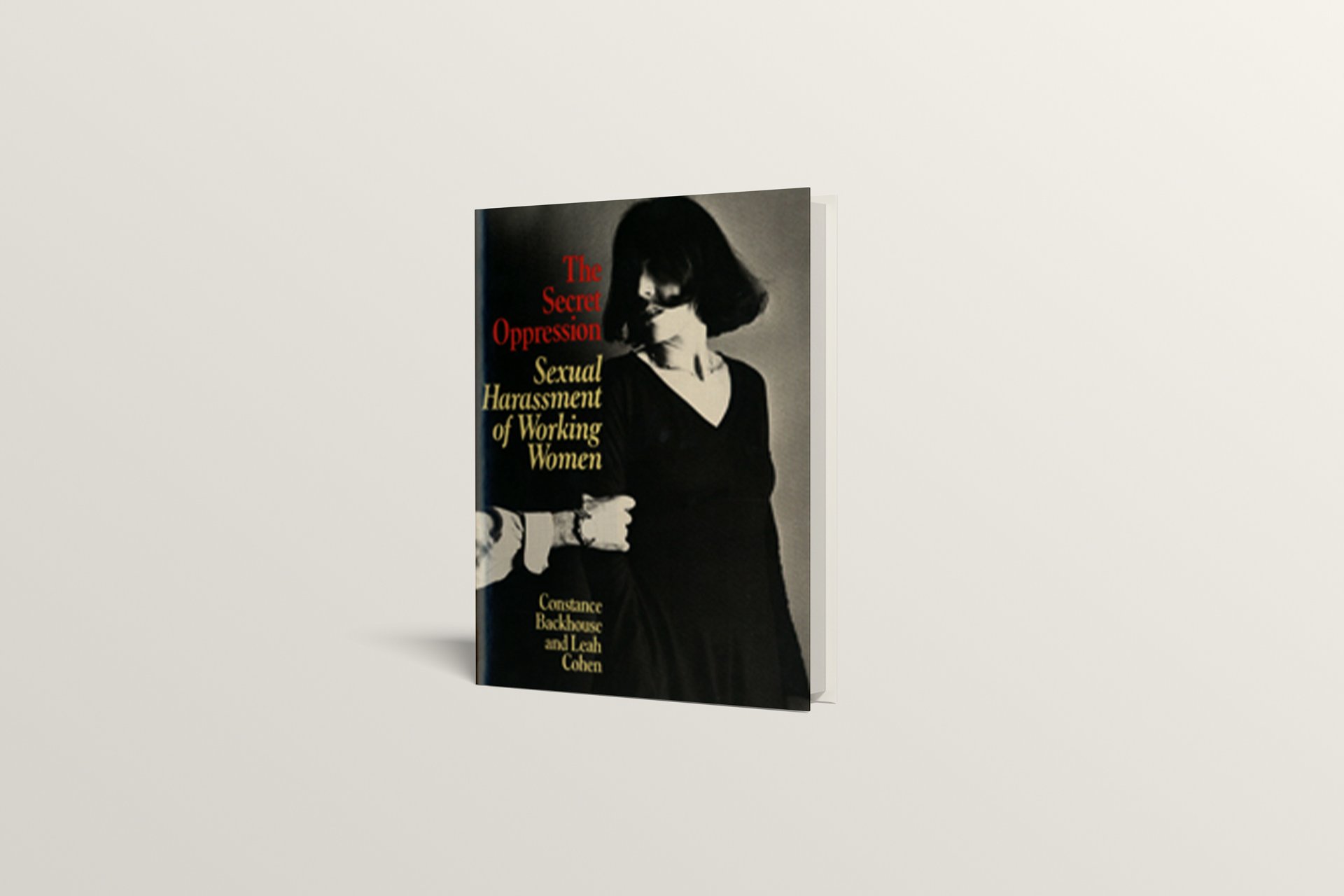
The Secret Oppression
Sexual Harassment of Working Women
Co-Authored with Leah Cohen
Macmillan of Canada, 1979
About
This book, published in 1979, was the first book about sexual harassment to be published in Canada, and the second in North America. Quotation from the inside flap:
“If you thought women have finally become more accepted as real people with readier access to the conclaves of corporate power, read this book—you'll think again. Using statistical studies, interviews with executives and personnel managers, case studies, historical records, and court cases, Constance Backhouse and Leah Cohen show how pervasive sexual harassment is in the workplace.”
The authors provide us with a balanced and incisive understanding of what goes on. They also recommend ways to combat sexual harassment. Since this subject has till now been unexplored, avoided, and rife with myths and misinformation, this book is all the more important to our society.